Monday, 15 August 2016

India: Lucy Rana mentors a group of 60 professors at Ramjas College


Mrs. Lucy Rana, Managing Associate Advocate at S.S. Rana & Co., recently delivered a lecture to a group
of 60 college professors at ‘Training the Trainers: IPR workshop’ hosted by Ramjas College, University of Delhi as part of their centennial year celebrations under the aegis of IPR Chair and Centre for Science Education and Communication (CSEC), DU. The topic of the lecture was ‘Introduction and Registration Procedures for Trademark and Geographical Indications’. The talk initially focused on the basics of Trademark law and Geographical Indications followed by the importance and practical aspects of Trademark and GI registration in India. The session was inaugurated by Mr. R. Saha, former director of TIFAC, and the current advisor to the Confederation of Indian Industry (CII), who started the workshop by delivering a lecture on the topic ‘Intellectual Property: Creating Wealth’.

Ramjas College is a college under the University of Delhi located in its North Campus. It is one of the first three colleges established under University of Delhi and admits both undergraduates and post-graduates, and awards degrees under the purview of the University of Delhi. Famous for its rich history and many traditions, Ramjas is widely renowned as one of the most famous higher educational institutions in India offering degrees in the liberal arts, the sciences, and commerce. Established by the great educationist and philanthropist, Rai Kedar Nath in 1917, the college is celebrating its centennial year of establishment this year.


Tuesday, 2 August 2016

India: Calcutta High Court ordered that only the Registered Proprietor of the Trademark can sue for its Infringement

On June 27, 2016, the Hon’ble Calcutta High Court ruled in favor of Three Leaves India Pvt. Ltd., by rejecting the plea of the Petitioner for extending the ad interim order of injunction. In the present matter, the Court also noted that a trademark infringement case can only be filed by the registered proprietor or the authorized licensee and not by the user of the trademark.

Case Summery
The Respondent, Three Leaves India Pvt. Ltd.,  was restrained from selling and/or offering for sale or market tea in a packet, the labels of which contained ‘Nowalty’ as it was similar to or a colorable imitation of the Petitioner’s,  logo or product ‘Lipton’ . It was further argued before the Court that the word ‘Lipton’ is a registered trade mark written in a distinct artistic font in unique shape. It was argued that the Respondent has not only infringed the trade mark but has also passed off its product in such get up and style which is deceptively similar to the trade design and get up of the Petitioner’s product. The Respondent’s advocate submitted that the suit for infringement of trade mark is not maintainable before this Court in view of Sections 52 and 53 of the Trade Marks Act (hereinafter referred as the Act) as the registration of the mark ‘Lipton’ stands in the name of Unilever PLC, a company registered under the laws of England. The moment those arguments were advanced by the Respondent, the learned advocate for the Petitioner took a rebound and drifted his stand in contending that the instant suit is filed for infringement of copyright and not for the infringement of trade mark and passing off action. The Court did not extend the ad interim order of injunction made ex parte on presentation of the documents by the Respondents detracting and demolishing the Petitioner’s case. 
Contentions of the Petitioner
  • The Respondent is marketing and selling its product through the mark ‘Nowelty’ on the packets in which the product is sold, which is similar and identical to the Petitioner’s label in trade design, graphics and color combination.
  • The word ‘Lipton’ is a registered trade mark written in a distinct artistic font in unique shape.
  • The Respondent has not only infringed the trade mark but has also passed off its product in such get up and style which is deceptively similar to the trade design and get up of the Petitioner’s product.
  • The relevant paragraph from the plaint was placed before the Court in a convincing manner, that it is a case of an infringement of a trade mark and in view of Section 134 of the Trade Marks Act, 1999 the proceeding can be initiated before this Court as the Petitioner are carrying on business within the territorial jurisdiction thereof.
  • The moment arguments on laws are advanced by the Respondent, the learned advocate for the Petitioner took a rebound and drifted his stand in contending that the instant suit is filed for infringement of copyright and not on infringement of trade mark and passing off action.
  • According to the Petitioner Section 62 of the Copyright Act 1957, confers the jurisdiction upon this Court and therefore, the present suit is maintainable in the Hon’ble Court.
  • By the deed of assignment of copyright the artist have assigned the artistic work in favor of the Petitioner and, thereafter the Petitioner as a proprietor of such copyright can initiate an action the moment the infringement is realized.
  • The cause of action for infringement of a copyright is averred and pleaded and, therefore, the suit should not be construed to have been founded upon the infringement of trade mark and passing off.
Contention of the Respondent
  • The suit for infringement of the trade mark is not maintainable before this Court in view of Sections 52 and 53 of the Act as registration of the mark ‘Lipton’ stands in the name of Unilever PLC, a company registered under the laws of England. According to the Respondent, there is no document annexed to this application evincing that the said trade mark is either assigned or a license has been given to the Petitioner to use the said trade mark.
  • There has been a gross suppression of material facts and the attention of the Court was not drawn to the relevant paragraphs of the petition from where it would discern that the entire case is founded on an infringement of a trade mark and passing off.
  • The Respondent, also highlighted several paragraphs of the petition where the Petitioner has categorically stated that he has a license of the registered trademark “Lipton” and possess rights in trade dress and overall get up of Lipton itself.
  • There is no fetter on the part of the Court in refusing or extending the ad interim order on the returnable date before inviting the Respondent to disclose facts in the form of affidavit if the materials produced by the Respondent are sufficient enough to demolish the case made out in the plaint as well as injunction application.
  • The Respondent referred the definition of a trade mark mentioned under section 2(zb) of the Act, to mean a mark capable of being represented graphically and which is capable to distinguish the goods or service of a person from those of others and may include shape of goods, packaging and combination of colors. He further drew the attention of the Court to a definition of the registered trade mark under Section 2 (w) of the Act to mean the trade mark which is actually on the register and remaining in force.
  • On the case of passing off, the Respondent contended that he is carrying on the business outside the jurisdiction of the Court, hence the present matter is not maintainable in this Hon’ble Court.
  • The Petitioner exploited his resources in securing the police assistance and help rendered to the Special Officer in carrying out the directions, passed on May 12, 2016, when the order does not indicate such police help.
Observations of the Court
  • A meticulous reading of the plaint would reveal that the Petitioner has categorically stated that he has a license of the registered trademark “Lipton” and possess rights in trade dress and overall get up of Lipton itself.The substantive reliefs claimed in the plaint are based upon the infringement of the trademark and passing off, except one, where the Petitioner also claimed a decree of permanent injunction against the Respondent from infringing the copyright.
  • Apart from a solitary prayer, the Court did not find any averments pertaining to its jurisdiction under the provisions of the Copyright Act.
  • The plaint as well as the injunction application lacks material documents relating to an assignment of the trademark in favor of the Petitioner.
  • An ad interim order in interlocutory proceedings does not necessarily bind the Court or the parties at the later stage of the proceedings. An ad interim order is usually made on the basis of the Petitioner’s version of things which is supported by an affidavit and the documents relied upon in the petition. If the ad interim order is made ex parte, the Respondents are permitted to present their version or documents to detract from the Petitioner’s case, on the returnable date.
  • The Petitioner has misused and mutualized its resources in procurement of the police help to render assistance to the special officer appointed by this Court in carrying out the directions passed on May 12, 2016.
  • The ad interim order was obtained by misleading the Court and causes immense sufferance to the Respondent.
Held

The Court declined to extend the ad interim order of injunction and also imposed a cost assessed at Rs. 2 Lakh, to be paid by the Petitioner to the Respondent. 

India: Delhi High Court orders that ‘artistic works’ related to ‘design’ can only be protected under the Design Act.

The Single Judge Bench of the Delhi High Court, in the case of OK Play India Ltd. V. Mayank Aggarwal & Ors., has ruled in favor of Mayank Aggarwal and other Defendants by vacating the previous ex parte ad interim injunction granted to Ok Play India Ltd.

In the present case, the Hon’ble Court analyzed the relation between the Copyright Act and the Design Act, and ordered that the Artistic works which are related to Design can only be protected under the Designs Act and not under the Copyright Act.

Brief Background

The Plaintiff, OK Play India Ltd., is a leading manufacturer and distributor of quality products made using plastic moulding technology including toys, school furniture and playground equipment. The Plaintiff is also the registered proprietor of the trademark ‘OK PLAY' since August 25, 2005.

The Plaintiff has sued eight Defendants namely Playwell Impex Private Limited, Mr. Mayank Aggarwal, Ms. Meenakshi Gupta, Mr. Pawan Kumar Gupta, Mr. Vishal Gupta, Mr. Darshan Singh Rawat, R.P. Associates and Funko India who are involved in manufacture and distribution of similar products. The Plaintiff claimed relief of permanent injunction to restrain the Defendants from infringing its copyright, common law rights in designs and passing off of deceptively similar products.

The ex parte ad interim injunction was granted to the Plaintiff vide order dated August 7, 2015 and the goods, of the Defendant, were seized by the Court Commissioner appointed vide the same order.

Contentions of the Plaintiff
  • That the products of Plaintiff are unique and conceptualized individually which involves studying the market, preparation of the drawings, coming up with a feasibility report, new color scheme, dimensions, etc.
  •  That the Defendant Playwell Impex Private Limited is engaged in the business of manufacture, distribution and sale of toys in collusion with the other Defendants including R.P. Associates who was earlier the distributor of Plaintiff’s products and Darshan Singh Rawat, who is an ex-employee of the Plaintiff. The Defendant Playwell Impex Private Limited has launched a range of toys which are identical and deceptively similar to the toys made by the Plaintiff and is thereby passing off its goods as those of the Plaintiff, infringing the bundle of intellectual property rights of the Plaintiff in its products.
  • That the toys manufactured and sold by the Defendants under the brand FUNKO are a substantial re-production and colorable imitation of the products of the Plaintiff.
  • There is a clear distinction between an original artistic work and a design derived from it for industrial application on a product. The original artistic work which may be used to industrially produce the designed article would fall within the meaning of the artistic work defined under Section 2(c) of the Copyright Act and would be entitled to copyright protection as defined under Section 2(d) of the Designs Act.
  • The Defendants in their written statement have admitted the e-mail of the Defendant Mr. Darshan Singh Rawat to the Defendant Playwell Impex Private Limited forwarding the brochure of the toys of the Plaintiff and therefrom it is evident that the Defendant Playwell Impex Private Limited is replicating from the brochure of the Plaintiff.

Contentions of the Defendant
  • That the drawing in which the Plaintiff claims a copyright does not constitute a design within the meaning of Section 2(d) of the Design Act and was thus, not capable of being registered under the Designs Act.
  •  That the Plaintiff has no right to claim protection of design without any registration.
  • That the Plaintiff’s toys which are being manufactured since the year 1992, are not novel and similar products are available in the market for ages.
  • That no interim injunction should be granted at this stage when infringement is not proved.

Observation of the Court
  • That if a design is applied to an article and re-produced for more than 50 times by industrial process after making a drawing then the drawing cannot be treated disjunctively from the said design and the copyright cannot be vested in such drawing. Section 15(2) of the Copyright Act expressly ends the said protection.
  •  That the Plaintiff’s products are manufactured more than 50 times by industrial process and their designs are registrable under the Designs Act. The protection of a design is for a maximum period of 15 years which has lapsed for the Plaintiff. No protection on the basis of copyright can be given to the Plaintiff at this stage.

Held

The application of the Plaintiff for interim relief is dismissed. The applications of the Defendants for vacation of the ex parte order and return of its goods are allowed. The goods seized by the Court Commissioner/s be forthwith released to the Defendant Playwell Impex Private Limited.
India: CGPDTM implements automated system for generation and issuance of Registration Certificates

The Controller General of Patents Design and Trademarks (CGPDTM) issued a public notice dated July 28, 2016 regarding the automated process of generation and issuance of Registration Certificate.  The notice states that from August 1, 2016 the Registration certificates will be generated through an automated system in accordance with the relevant provisions of the Trade Marks Act & Rules and shall be made available to the applicants concerned or their authorized agents on record.

The Registration Certificates will be issued for the Trademark Applications
  • which have been published in the Trade Marks Journal Number 1720 dated 23.11.2015 and thereafter,
  • where  no request for amendment filed on behalf of the applicant is pending for disposal,
  • where the copy of original application for registration is available in the Trade Marks Registry’s electronic database,
  • where no requirement (like fee, Power of Attorney, etc.) is pending for compliance on part of the applicant , and
  • Which have not been specifically prohibited for registration by the order of any court, IPAB or any competent authority.

The cases which are left out by the automated registration process due to the reasons aforesaid will be processed as per law by the Registration wing of the Examination Publication and Registration Section of the TMR Mumbai through the present Trade Marks System on a case to case basis.

Further the Registration Certificates generated through this automated process will be transmitted to the Applicant concerned or his authorized agent on record on their email address for which it is advised by CGPDTM to provide their valid email id with the HO/Front Office Counter of the respective TMR Offices for facilitation of quick transmission of registration certificates.  

The Registration Certificates will also be made available on the CGPDTM official website www.ipindia.nic.in along with status of the application concerned.


India: CCI introduces Guidelines for Assessment of Economic Legislations and Policies

The Competition Commission of India (CCI) in order to warrant that economic legislations are appropriate and do not adversely affect competition have introduced Competition Commission of India (Competition Assessment of Economic Legislations and Policies) Guidelines, 2016, which enumerates guidelines for assessing of legislation from the competition perspective.

Salient features of the Guidelines
  • To prevent implementation of legislation that may cause appreciable adverse effect on competition- With the object to ensure transparent assessment of select economic legislations and policies made and framed by the Parliament, State Legislatures, any Ministry or Department of Central or State Government from a  competition perspective, the Competition Commission of India (CCI) has come up with the Competition Commission of India (Competition Assessment of Economic Legislations and Policies) Guidelines, 2016. If required, the CCI would suggest any modifications in the legislation or policy. Thus, by such assessment, the CCI seeks to prevent implementation of any provision that might cause appreciable adverse effect on competition.
·         Sources for Policy assessment: 
  1. The Advocacy Division of the Commission will continuously scan and identify the economic legislations and policies (existing and upcoming) which may potentially have adverse effect on competition;
  2. Any Government Agency may refer any economic legislation or policy to the Commission for competition assessment;
  3. The Commission may identify any economic legislation or policy for assessment. 
  • Expert panel of the Commission for Policy assessment- The panel constitutes of 5-7 reputed institutions having expertise in law, economics, finance or management to carry out initial competition assessment of the economic legislations or policies referred to them.
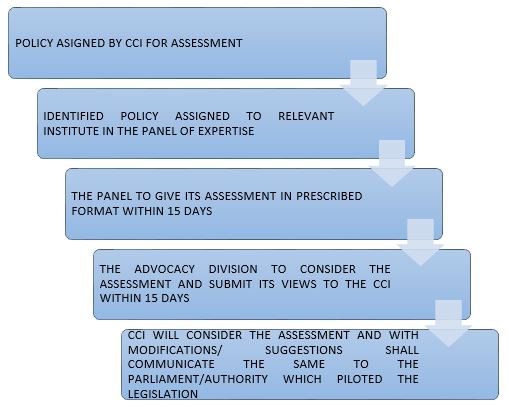
  • Process of Assessment- Various steps involved in policy assessment are demonstrated below:
These Guidelines will be effective from January 1, 2017 and remain in force until further reviewed by the Commission.

Friday, 22 July 2016

India: Relaxation in ‘Startup India’ Norms

The ‘Start- up India’ initiative was launched by Department of Industrial Policy and Promotion (herein referred to as ‘DIPP’) in January, 2016, to encourage entrepreneurship and innovation by providing supportive eco-system, eased regulatory mechanism and funding the budding enterprises. Despite initial optimism, many irregularities were perceived like technical and rigid registration procedure, incubators charging fee imprecisely, lack of monitoring authority and absence of instructing unit. Our prior publication dated June 6, 2016 reported that out of 250 applications filed for seeking benefits under the scheme, only 1 got approved. Witnessing these issues and acknowledging the hassles it creates, the government has come up with simplified norms.

Let’s start with the eminent alterations made. Firstly, the requirement to obtain a certificate of Eligibility from the Inter-Ministerial Board of DIPP has been removed in case of IPR-related matters. Now a certificate of recognition of DIPP would suffice the eligibility criteria to avail IPR-related benefits. Furthermore, the fee of incubator has been fixed to Rs. 5,000 and is limited to Rs. 10,000, in case, the experts’ assistance is taken from outside to assess the innovative idea put forth by a startup. As per the procedure, the startups needs to take letter of recommendation from the incubators before registering on the Startup India portal. The government has also certified 20 private organizations as incubators and is planning to create sector specific incubators under the Atal Innovation Mission along with 500 tinkering labs to provide pre-incubation training and a seed fund for high growth startups.  To keep a check on these reforms, the DIPP has formed a monitoring committee which will take stock of action plan’s implementation once a month.

In another initiative, the DIPP will be launching a learning module on the startup India portal, which will have all the information on how to move forward with an innovative idea. To finance the scheme, the government has already declared the fund for startups in the budget and Rs. 2,500 crore will be released each year for over next four years. After the passage of Finance Bill, the tax benefits will also be extended to aspiring entrepreneurs. These reforms are anticipated to foster innovation and boost entrepreneurship spirit in Country’s youth. 


Recently, the DIPP has again issued a public notice on July 11, 2016 intimating that two provisions in the Scheme have been updated:
  • The definition of “start-up” has been revised and the definition of start-up as rendered in explanation 5 of Notification 180(E) published in Part II, Section 3, Sub-section (i) of Gazette of India dated 17.02.2016 would be applicable now.
  •  The revised Scheme uplifts the requirement by a start-up to obtain certificate of eligible business from the Inter- Ministerial Board of Certification
Guidelines for Facilitators and start-Ups for filing and processing for patents, designs and trademarks- The Office of Controller General of Patents, Designs and Trademarks (CGPDTM) has on June 08, 2016 issued Guidelines for Facilitators and start-Ups for filing and processing for patents, designs and trademarks. The Guidelines enumerate general provision for the filing and processing of patent, designs and trademark applications in India. 

The endeavours being taken by the Government to encourage innovations and creativity by start-ups is noteworthy. In view of these relaxed rules and facilitations we expect that more and more start-ups would protect their IP and become IP-intensive companies.

India: UGC directs all the major varsities to offer IPR as an elective subject

The University Grants Commission, while reiterating the importance of Intellectual Property Rights, has asked universities to offer it as a generic elective subject under the Choice Based Credit System.

In a letter to universities, UGC secretary, Jaspal S Sandhu said that creations of mind such as inventions, designs for industrial articles, literary, artistic work, symbols, names and images, etc., are protected by Intellectual Property rights. The letter also stated that IPRs should be protected to encourage the creator and also striking a balance between the innovators and public interest by creating an awareness where creativity can flourish.

Keeping in view the importance of IPR which recognizes the work of the creator, the universities are requested to devise, through academic council, inclusion of IPR as a generic elective subject under the Choice Based Credit System (CBCS) in their universities and all other affiliated colleges.